Is a Slip Lead Right for My Dog? A Practical Checklist
A slip lead is not the right default for every dog. Decide by how your dog walks, how comfortably they accept equipment, and whether you can avoid neck pressure. Persistent pulling, uncertain fit, or health concerns call for another setup or individual advice first.
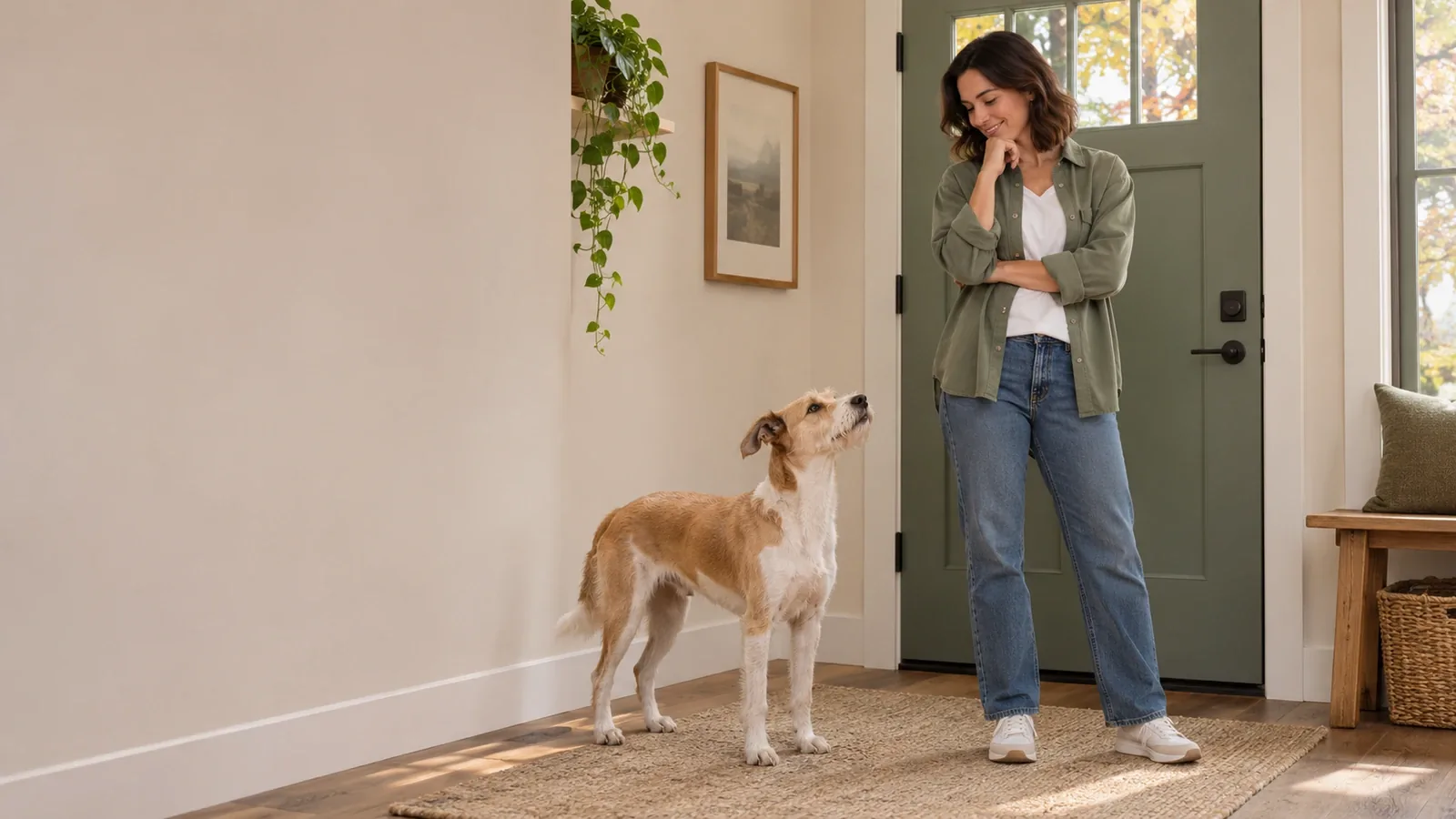
A slip lead is not the right default for every dog. Decide by how your dog walks, how comfortably they accept equipment, and whether you can avoid neck pressure. Persistent pulling, uncertain fit, or health concerns call for another setup or individual advice first.
An easy-on design can look appealing when you want to get outside without sorting through several pieces of gear. But a quicker departure is useful only if the equipment also suits the dog and the person holding it. Start with your ordinary walk, not the most polished product photograph.
What Makes a Slip Lead Different?
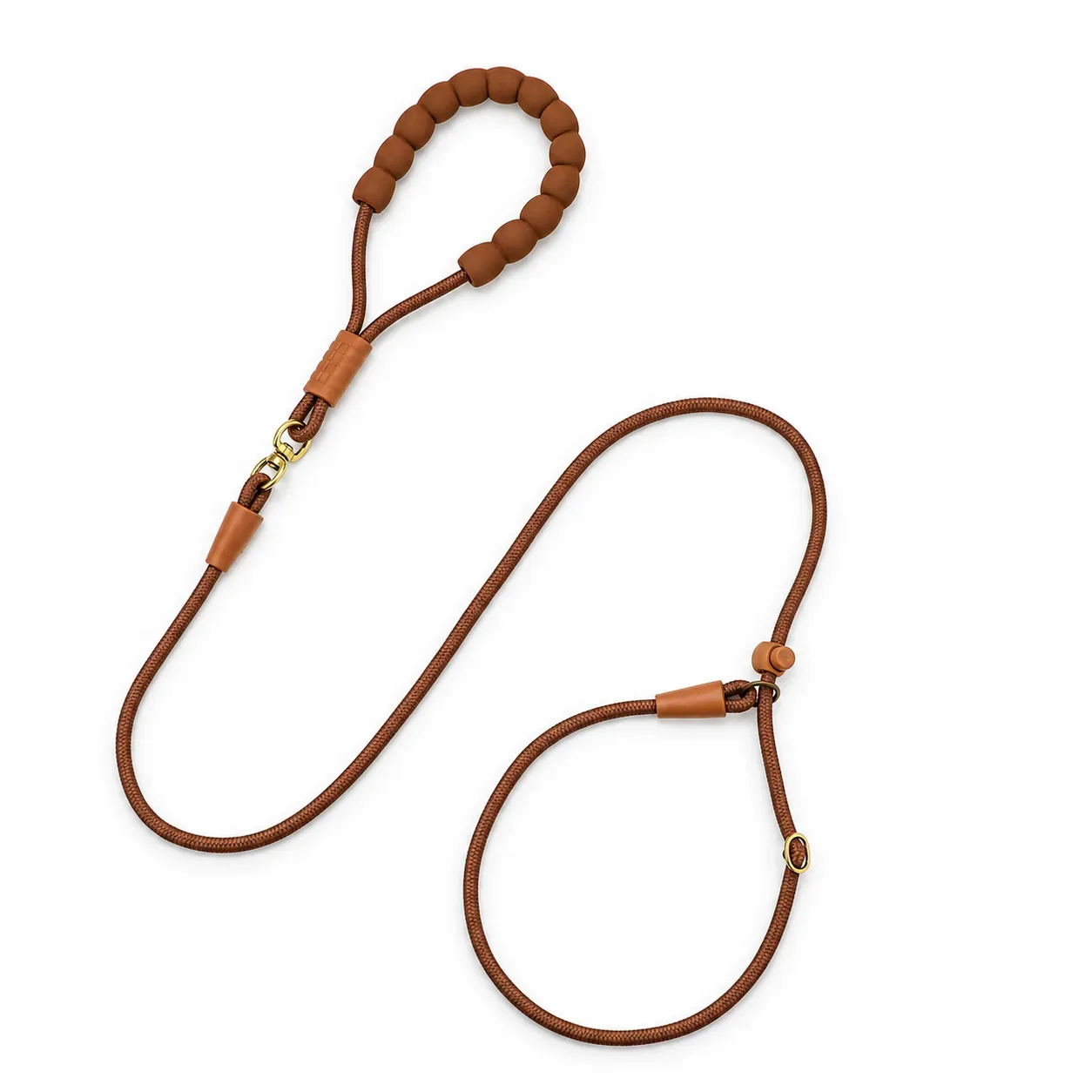
A slip lead combines the lead and a neck loop in one piece. Unlike a regular leash clipped to a separate collar or harness, its loop can change size as the line moves through the fitting. That difference matters more than the rope's appearance.
Do not assume that a sliding stopper makes the loop a fixed-size collar or prevents pressure on the neck. It is a component to understand and inspect, not a reason to ignore how the dog moves.
The useful buying question is not simply whether a slip lead goes on quickly. It is whether this design fits your dog's behavior without relying on tightening to manage the walk. If your current harness-and-leash combination works comfortably, there is no need to replace it just to simplify the equipment list.
Ask Four Questions Before You Choose
Use a familiar walk as your reference: leaving home, passing a driveway, noticing another dog, and pausing to sniff. A quiet demonstration indoors may not show what happens outside.
| Question | What to notice | Next step |
|---|---|---|
| Does the line usually stay loose? | Pulling, lunging, or repeated tension | Work on walking skills with suitable equipment first |
| Is equipment handling comfortable? | Backing away, freezing, or avoiding the loop | Slow down and seek help if concern persists |
| Are there individual health concerns? | Known neck or breathing conditions | Ask your veterinarian before choosing neck-based equipment |
| Can you handle the actual route? | Crowded exits, distractions, or difficulty managing slack | Keep a familiar setup while reassessing the outing |
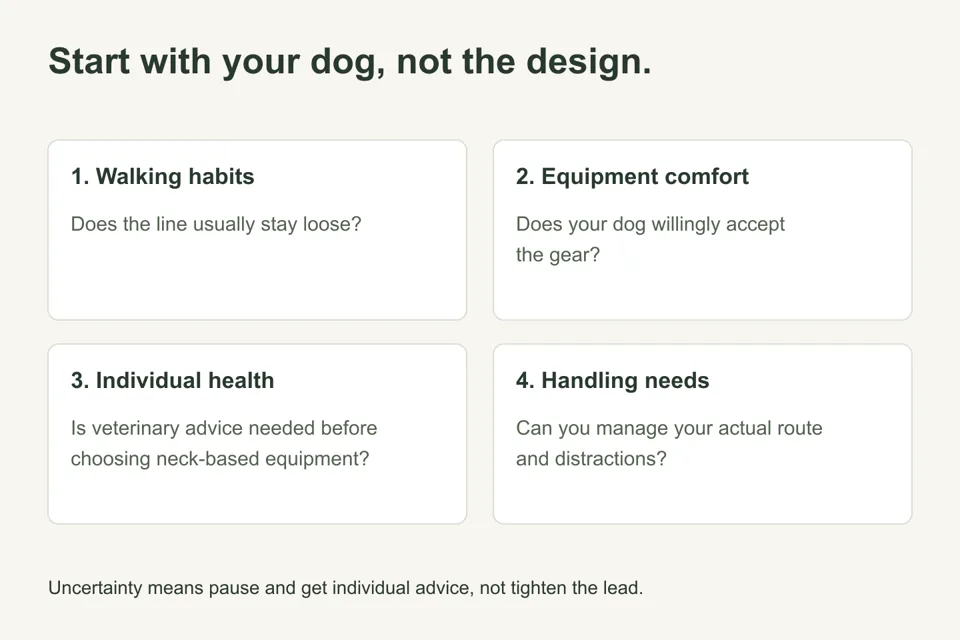
1. Are you choosing equipment or trying to fix pulling?
These are different jobs. Changing a leash does not teach the dog what to do when a squirrel appears or the sidewalk gets busy. If your reason for buying is that tightening might discourage pulling, pause the purchase and address the walking problem instead.
Battersea's loose-lead walking guidance advises avoiding slip leads for this training because they can tighten around the neck and cause discomfort. That is an important limit, even when a product is described as suitable for everyday walks.
2. Does your dog willingly accept the equipment?
Notice the approach as well as the walk. A dog moving away when the loop comes out is not asking for a faster fitting process. Give them room rather than chasing their head with the equipment.
Battersea's equipment-introduction advice recommends progressing at the dog's pace and seeking veterinary or behavior support when pain or fear is involved. Familiarity should develop through comfortable experiences, not by forcing the first attempt.
3. Is there a reason to avoid pressure at the neck?
The My FurMigo product instructions specifically direct owners of dogs with neck or breathing conditions to ask their veterinarian whether a slip lead is appropriate. Do not treat a different length, soft-looking rope, or a looser initial adjustment as a substitute for that advice.
If you are unsure about a reaction to walking equipment, resolve the uncertainty before trying to complete a normal route. An article cannot assess an individual dog's fit or health.
4. Would the setup suit the person holding it?
Think about the least convenient part of your outing. Perhaps you need to close a building door, collect waste, or step aside on a narrow path. Choose a setup you can manage without repeatedly taking your attention away from the dog.
Also consider shared handling. A lead that one person understands may be unfamiliar to a visiting relative or dog sitter. Explain the equipment and its limits rather than assuming that a simple-looking design needs no introduction.
When a Familiar Harness and Clip-On Leash Make More Sense
For a dog still learning walking skills, regularly pulling, or struggling with distractions, start with individual equipment advice and a reward-based plan. A slip lead should not be the shortcut that replaces either.
The American Veterinary Society of Animal Behavior recommends reward-based training and explicitly rejects leash corrections. Do not add jerks, deliberate tightening, or sustained neck pressure to make a walk appear more controlled.
A harness also needs to fit the individual dog. If that is your current setup, use the harness-fit checklist to review it rather than assuming every harness solves every handling problem.
For a newly adopted dog whose responses you do not yet know, the first-walk checklist offers a more useful starting point: familiar equipment, a manageable route, and room to turn back.
Where the Everyday Slip Lead Fits the Decision
If a slip lead remains an option after considering those questions and obtaining any individual advice needed, compare the actual design rather than a broad category label.
The My FurMigo Everyday Slip Lead Dog Leash has nylon construction, a textured handle, and a sliding stopper. The published instructions describe opening the loop, placing it gently over the head, adjusting it, and checking the equipment before departure.
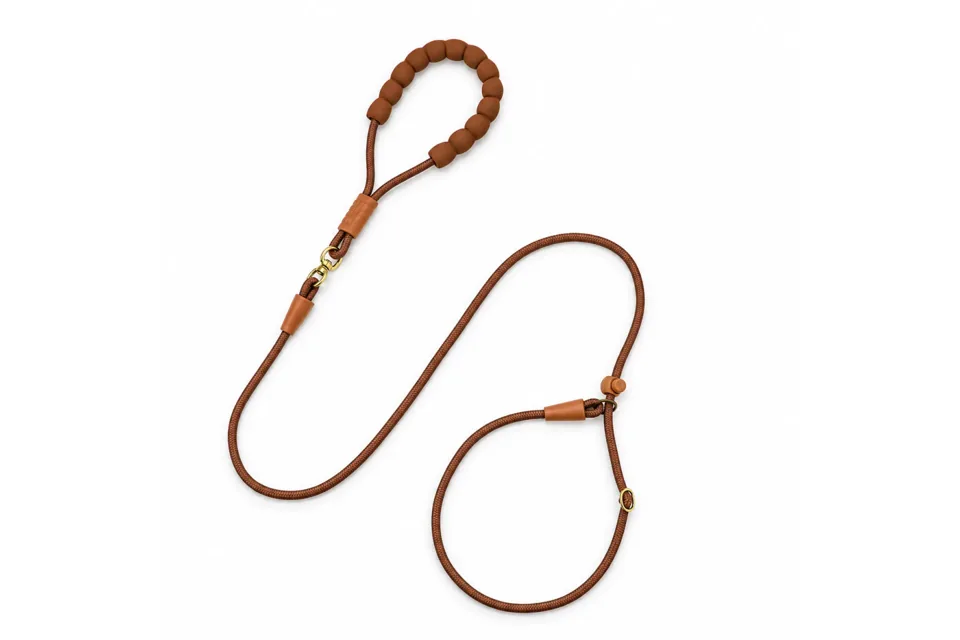
Those are handling features, not evidence that the product stops pulling, prevents escape, or suits every dog. Check the current product instructions and ask for clarification if you cannot tell how the loop should behave. Do not improvise a different routing or convert the lead into another kind of restraint.
Read the Length Options as Lengths, Not Dog Sizes
The product lists S at 47.2 inches (1.2 m), M at 59.1 inches (1.5 m), and L at 70.9 inches (1.8 m). These labels identify lead lengths; they do not establish a recommended breed, body weight, or neck measurement.
Picture the space between your hand and the dog on your actual route. Consider your position, the dog's height, and how you manage spare line. Do not assume the longest option automatically gives the best walk, or that a shorter option makes tightening acceptable.
If the information you need is missing, ask before ordering rather than converting the size letter into an unsupported fit recommendation.
Make a Pre-Walk Check Part of the Routine
Before relying on a new setup:
- Read the instructions for that exact lead, not a similar-looking model.
- Inspect the rope, handle, stopper, and fittings for damage.
- Resolve any uncertainty about fit or loop movement before leaving home.
- Choose an outing you can shorten if the dog or equipment is not comfortable.
- Keep appropriate identification and cleanup supplies in your usual walking plan.
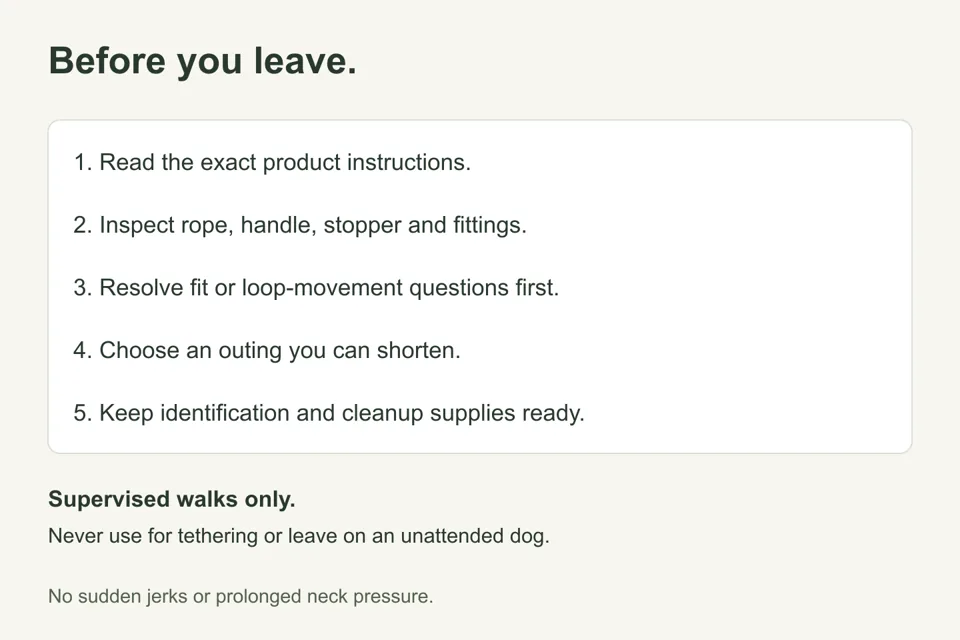
The manufacturer's limits are clear: use the lead only during supervised walks, never leave it on an unattended dog, and do not use it for tethering. Avoid sudden jerks and prolonged pressure at the neck. A quick trip is still a supervised outing, not an exception to those limits.
Frequently Asked Questions
Will a slip lead stop my dog pulling?
Do not buy one expecting that result. Treat pulling as a walking-skills and equipment-selection question, not a reason to use tightening as a correction. Seek a reward-based trainer's help if you cannot manage the situation comfortably.
Does a sliding stopper make a slip lead escape-proof?
No such guarantee is established by this product's published information. A stopper is not evidence that the lead cannot slip off or tighten. If escape is a concern, ask for an individually assessed equipment plan.
Can a slip lead replace my dog's identification collar?
Do not confuse temporary walking equipment with your identification plan. Keep contact details current and check the identification requirements that apply where you live; this product is not presented as an ID system.
Can I leave it on while my dog waits outside?
No. The product instructions prohibit unattended use and tethering. Do not attach it to furniture, a fence, or another fixed point while you step away.
Should I choose S, M, or L based on my dog's weight?
Not from these labels alone. The listed options specify lead length, not weight capacity or a verified dog-size recommendation. Check the measurements and ask about any fit information that has not been provided.
Conclusion
Choose walking equipment around the dog and the outing, not departure speed alone. If pulling, discomfort, or fit is unresolved, keep working on those questions before changing the setup. If a slip lead remains appropriate to consider, review the Everyday Slip Lead's instructions and length options with those limits in mind.
Shop this story
Continue exploring
Walk & Explore
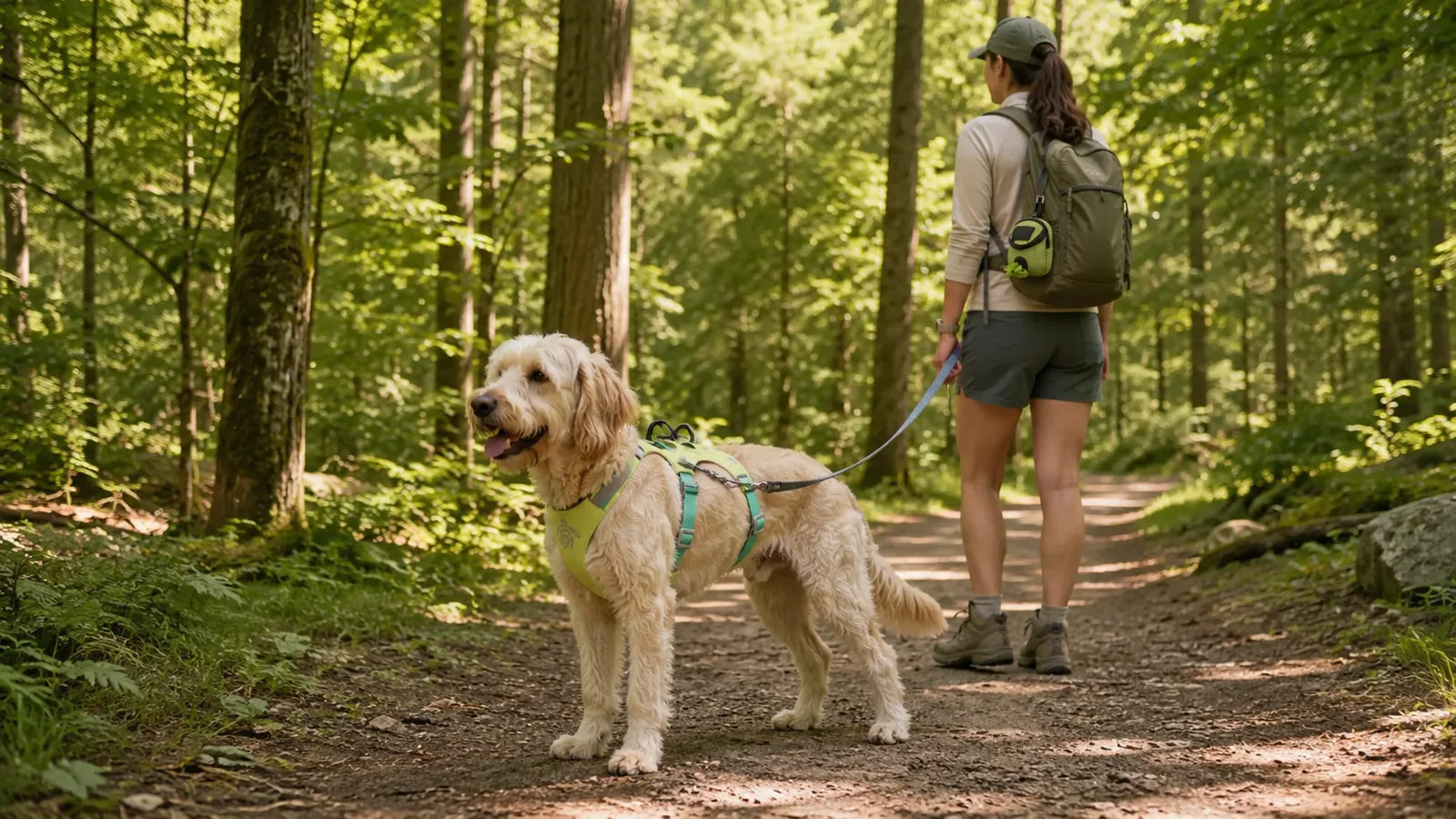
What to Pack for a Summer Day Hike With Your Dog
For a summer day hike with your dog, pack more than a leash and a shared water bottle. At minimum, bring water specifically for your dog, a portable drinking bowl, secure walking gear, current identification, waste bags, familiar treats, basic first-aid supplies, and a plan for shade and rest.
Read story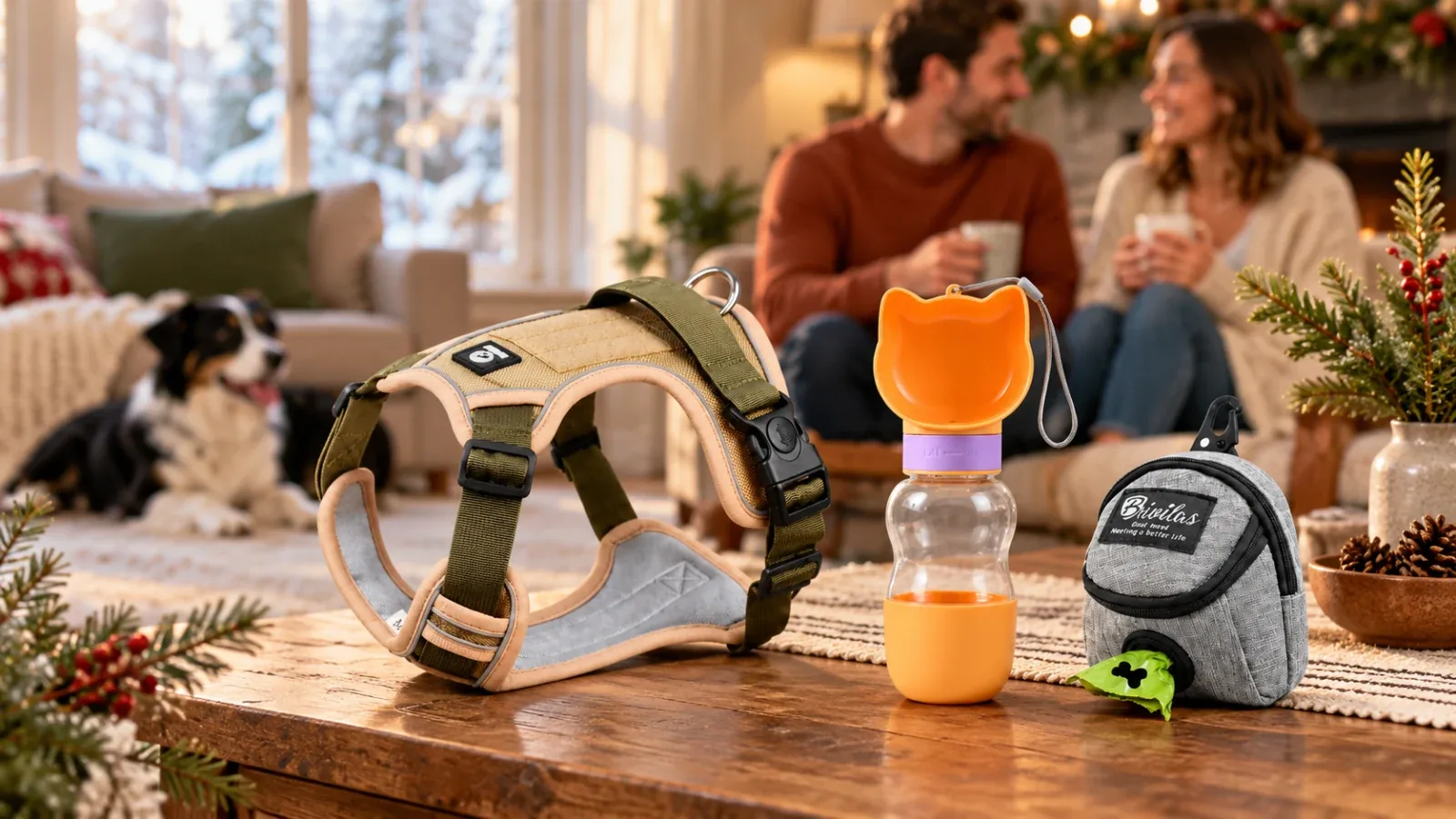
Walk & Explore
Holiday Walking Gifts for New Dog Owners: What to Choose
The most useful holiday walking gift for a new dog owner fits the dog and makes a daily task easier. If you know the dog's measurements and the owner's routine, a walking kit may work. If you do not, choose a lower-fit-risk item or select fitted gear together.
Read story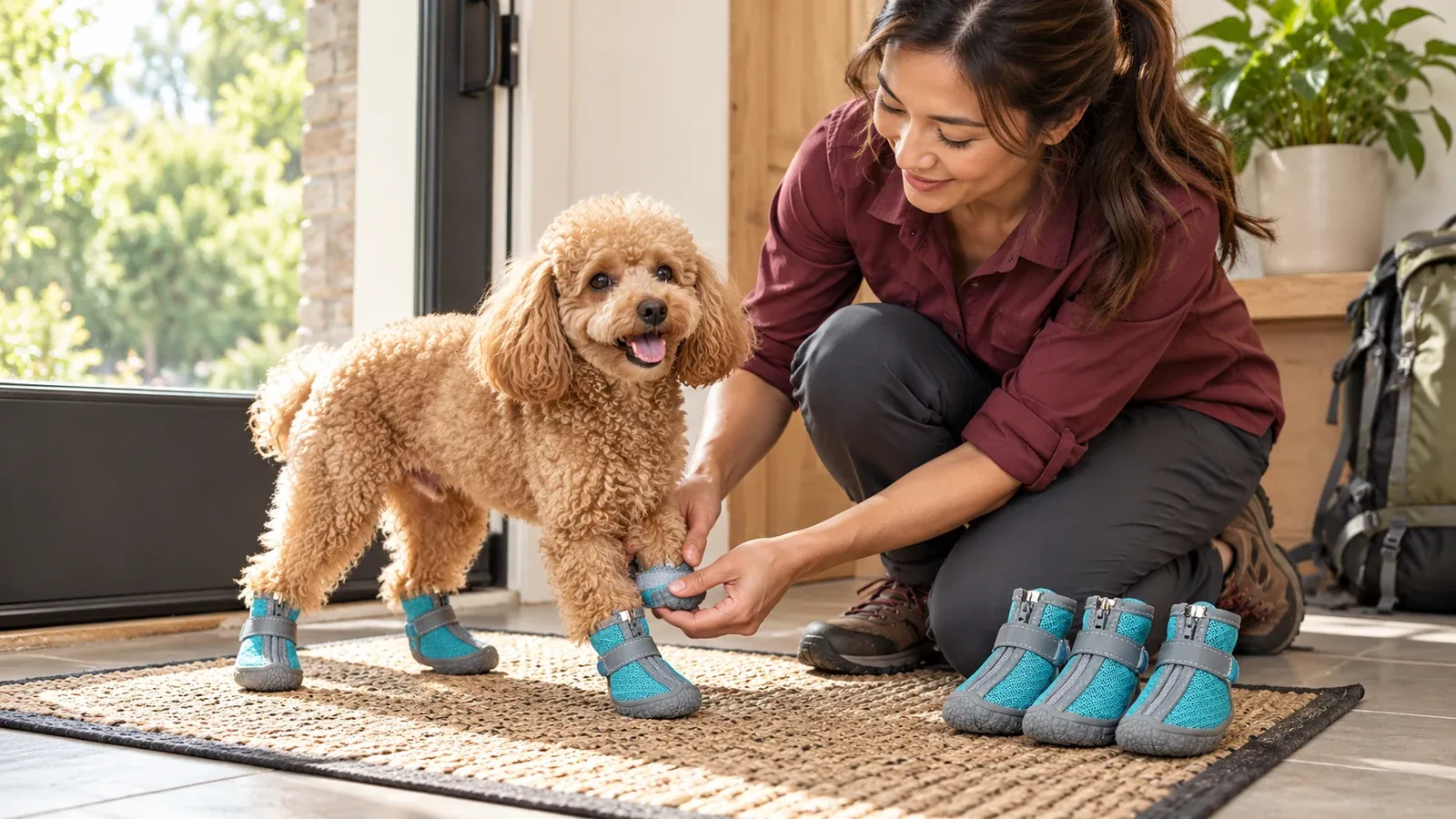
Walk & Explore
How to Get a Dog Used to Boots Before Hiking
Get your dog used to boots well before hike day: measure weight-bearing paws, introduce one boot indoors, reward a few calm steps, then add the remaining boots and short outdoor practice. Recheck fit and skin after every session.
Read story